Cheap and cheerful alternative to fluid.grid~ for larger data sets?

So due to a good breakthrough with fluid.jit.plotter (via some new info/knowledge from the Max beta forum being passed to @balintlaczko) I’ve been resisting 2d plotting of datasets for corpus scrubbing ala CataRT et al.

At the moment I’m doing something like this (ala my old experiments with fluid.datasetplot~):
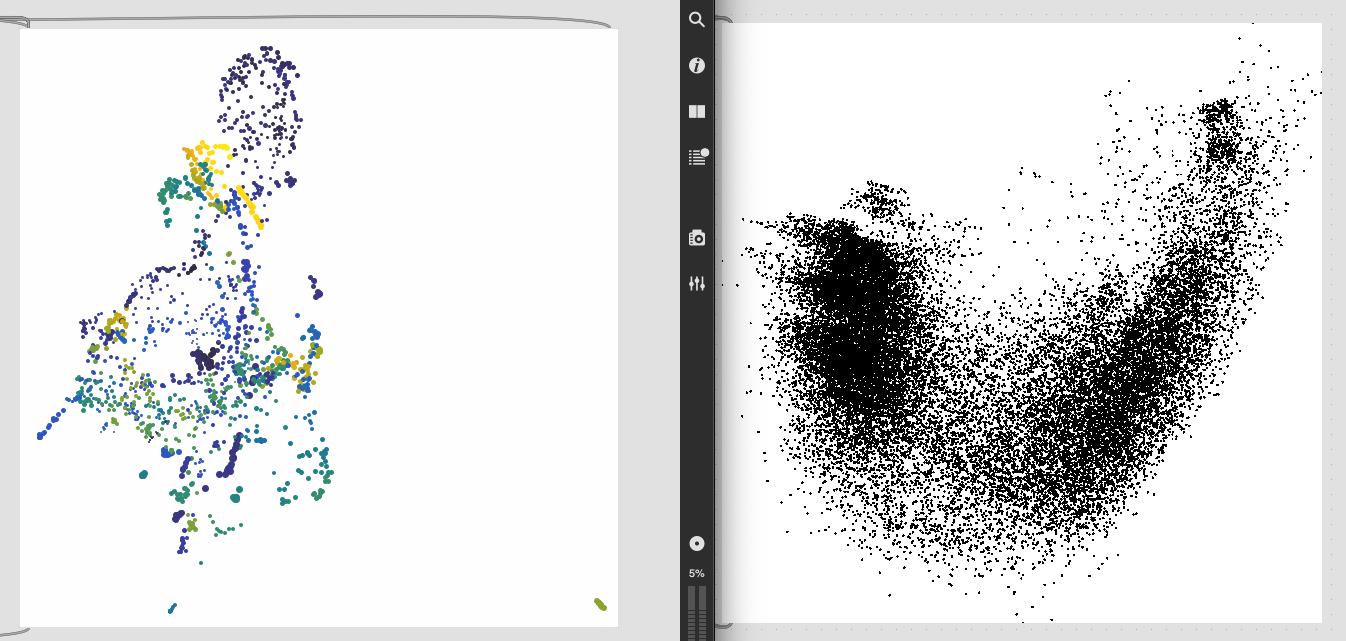
This is really cool/handy for using a mouse, but I’d like to be able to navigate this with a gamepad or other grid-y surfaces.

Sadly fluid.grid~ absolutely chokes on a dataset of any significant size (as it turns out!). The dataset on the right is ~30k points and that pinwheeled Max for like 5min before I decided to just force quit it.

I imagine it’s doing loads of stuff trying to optimize the relationships between all the points, but for larger data, it seems like that’s not really viable. And there’s not really a lot of parameters to tweak with the algorithm to try and make it faster/dumber, so I’m wondering if there’s a cheap/fast way to make something grid-y out of larger datasets like this. Like some kind of brutal ordering/quantization or something like that? And/or is there any settings or pre-processing that can make fluid.grid~ happy with 30k data points.
1 Like

Ok I spent a bit of time this morning playing around with fluid.umap~ and although it’s quite a bit slower than I’d like, I can seem to make “circles” out of it, which is better than loop-de-loops.

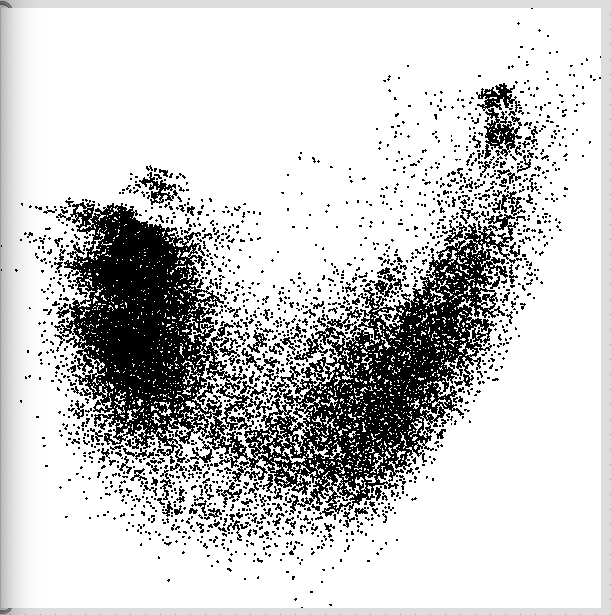
For reference, with the ~30k dataset above, PCA takes 150ms to make this shape:

So that’s effectively “instant”.

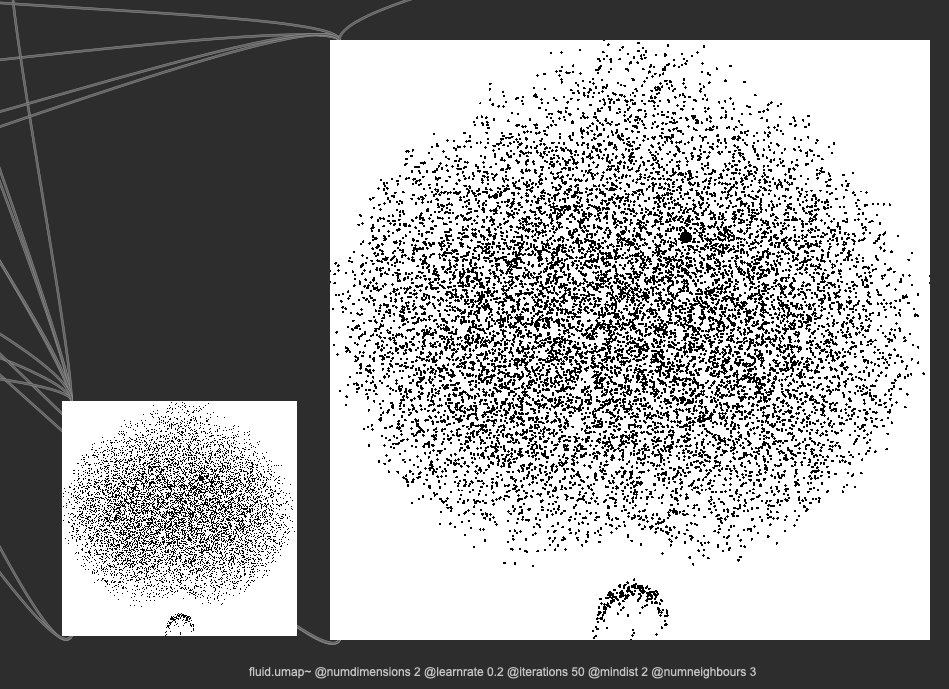
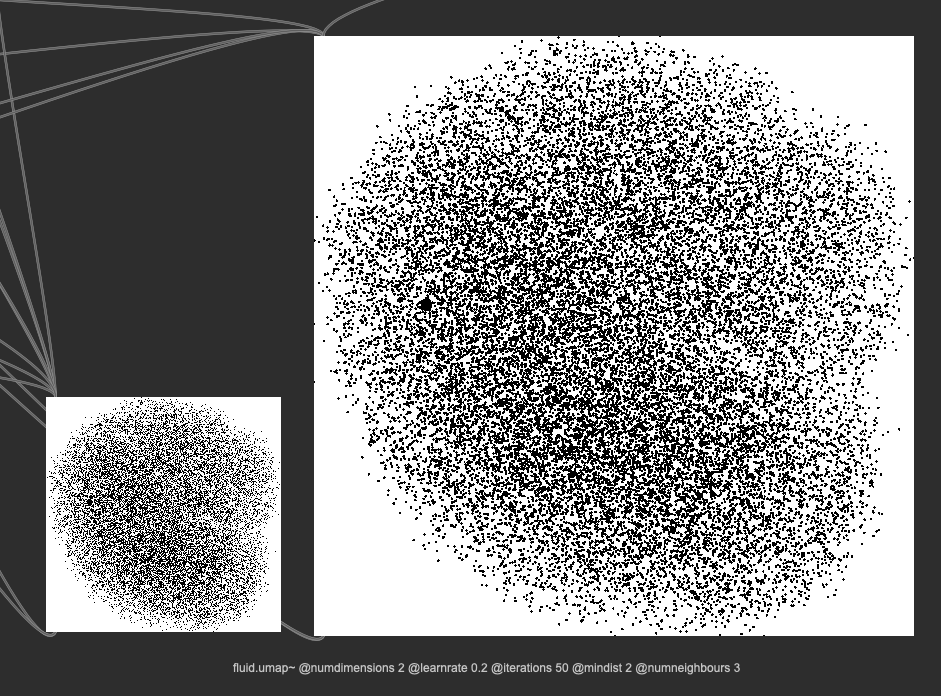
And here is my best result with fluid.umap~:

You can see the settings below it, and this took ~13s.

So a few orders of magnitude slower, but a fair use of the space. Navigating it also sounds alright (some more extreme settings made a more evenly distributed circle, but the distribution sonically felt more random internally)

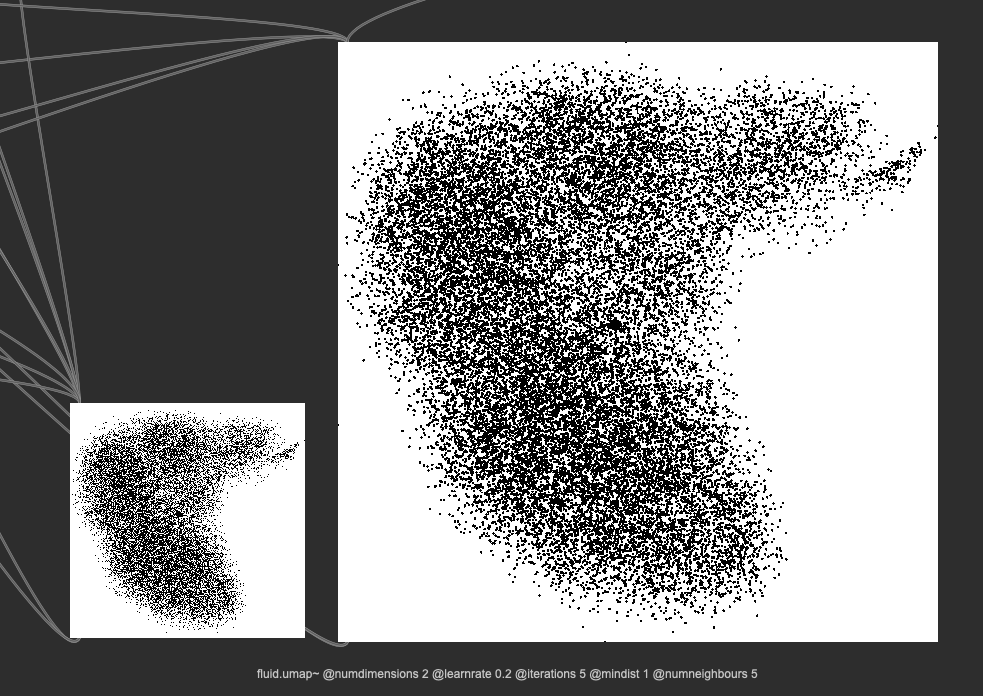
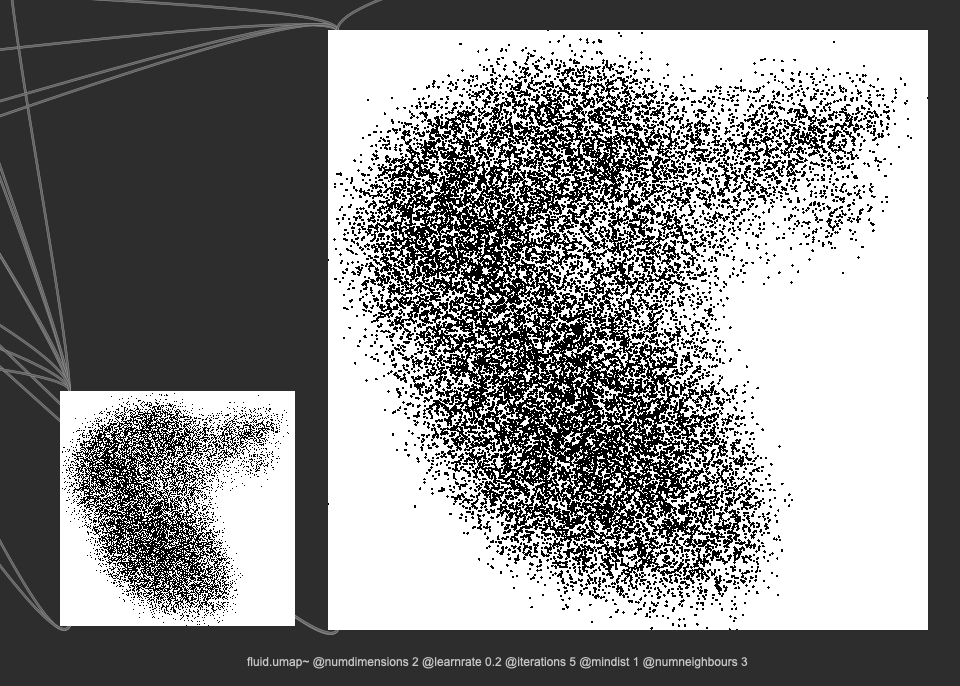
And here’s the same settings on a different corpus (~14k points):

This took about 4s, though it has produced a bit of an appendage. Playing with the settings it seems to make it more or less pronounced without ever getting rid of it.

//////////////////////////////////////////////////////////////////////////////////////////////////////////////////////////////

And here are some other settings and their durations:

This took 20s, and represents my first experiments of just trying way way less iterations. And it’s kind of a fuzzier version of the PCA shape, which is an improvement, though super slow.

By reducing the numneighbours I get something even fuzzier, and much faster:

This one took only 9.5s.

So that led me to focus on numenighbours as the main “rounding” factor. Bringing that quite low gave me this (in 8.5s):

So already kind of round-ish.

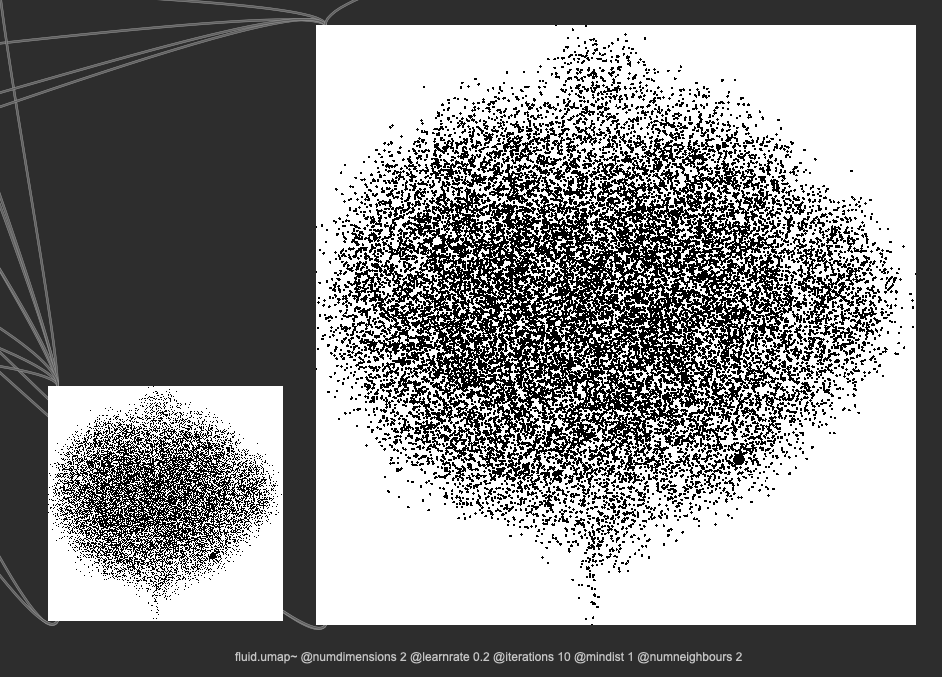
So overall the numneighbours appears to be the rounding factor, with 3 seeming like a sweet spot, although 2 also works pretty well.

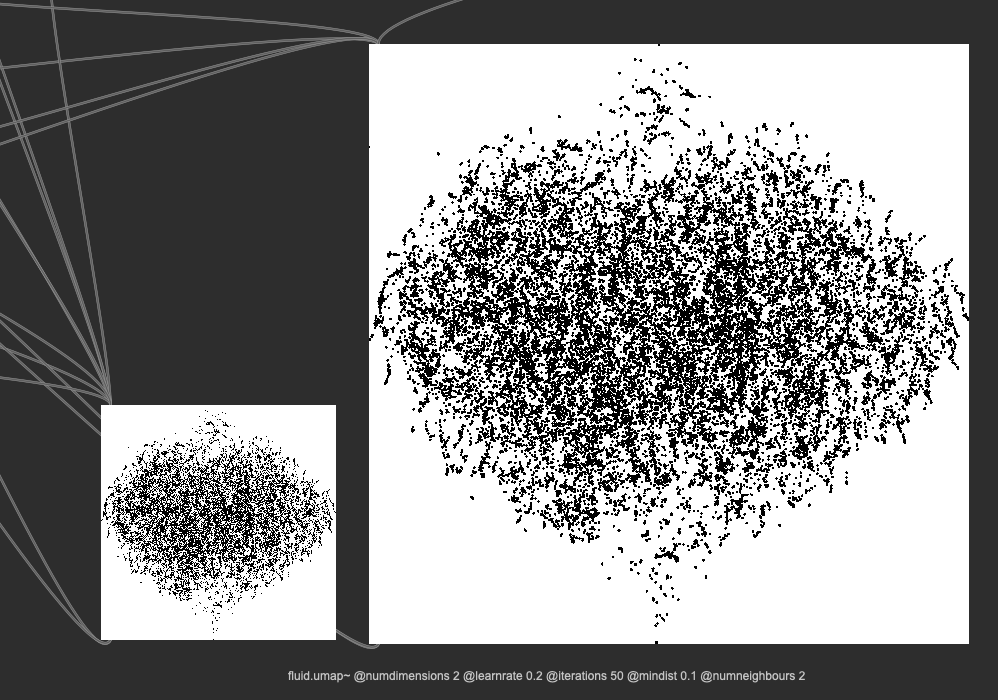
I would have thought mindist would be the deciding factor given what it’s computing, but at rather small values you get wrinkle textures (@mindist 0.1 in 10s):

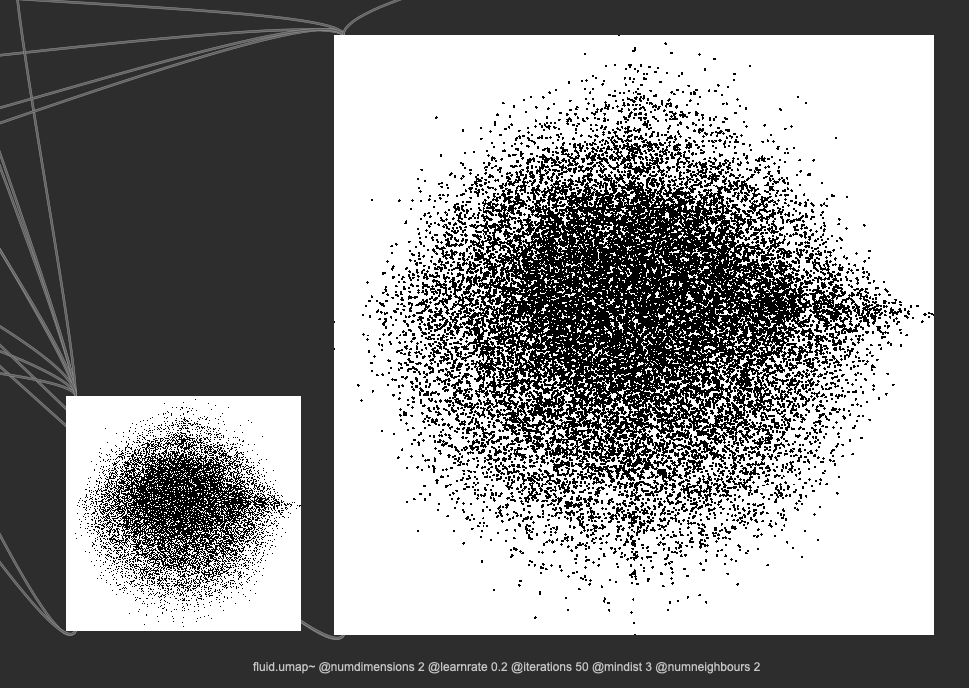
And pushing it the other way up to @mindist 3 gave me this (in 10s):

//////////////////////////////////////////////////////////////////////////////////////////////////////////////////////////////

So this use of UMAP gives passable results, in that if you’re willing to wait ~12s, you can get a shape that better uses a 2d plane, but definitely too slow to be a default.

Ideally it would properly use the 2d plane by taking up the corners too, but this is a start at least.

The bad news is that this type of algorithm is intrinsically very expensive. I believe that there may be more approximate versions that could be less so, but I don’t really know what they are. Maybe we should have a vague feature request for someone to investigate that.

2 Likes

I’ll make an FR on the git with this thread as a link.

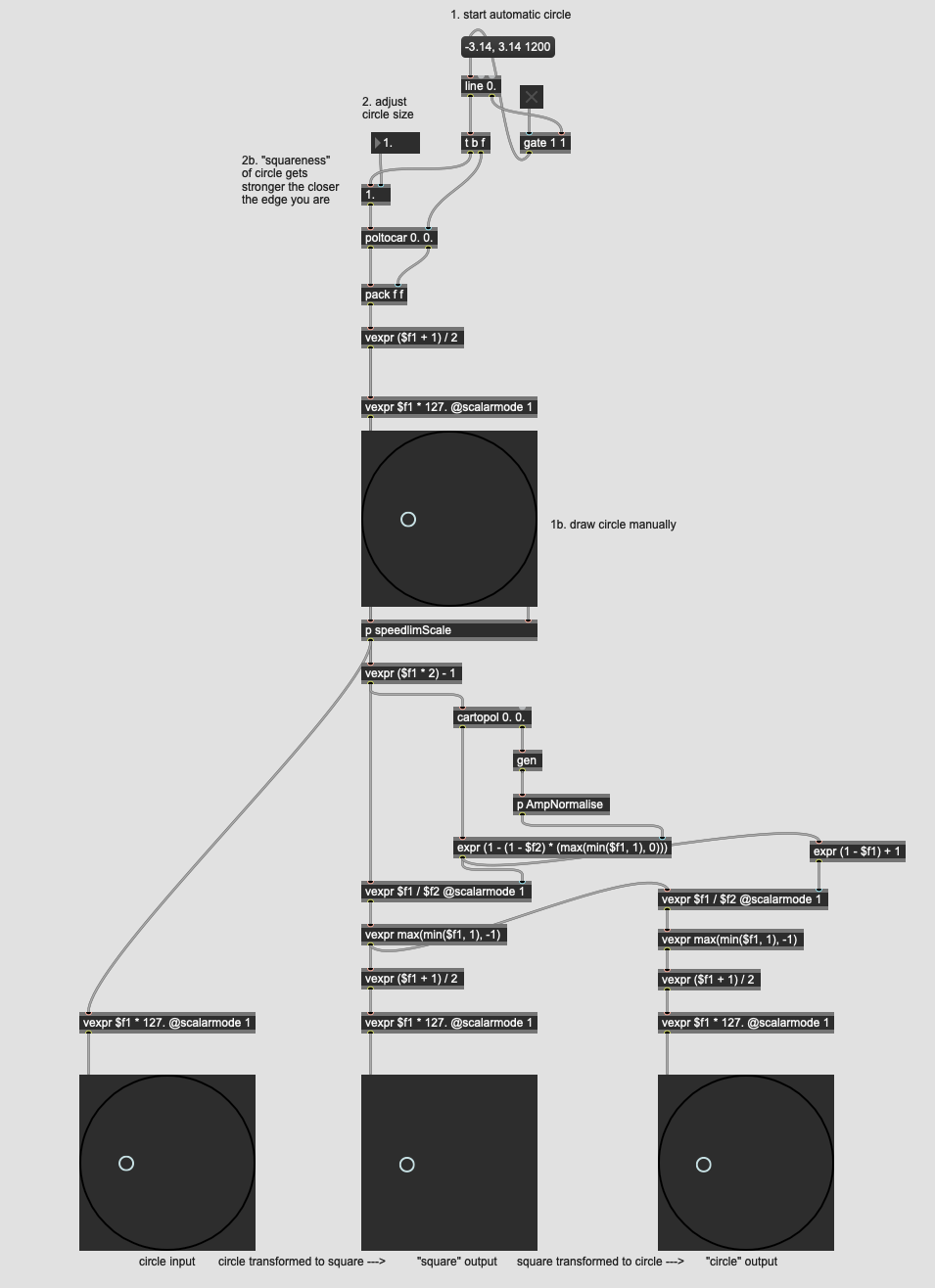
As an aside, for my immediate use case, I got to thinking that rather than trying to transform complex data, that perhaps it’s easier to just transform my input controller data instead. Since my intention here is to use a 2d control space (with an XY grid or a gamepad), that as long as I can get UMAP in to a circular shape, that I can perhaps map a 2d “square” onto a 2d “circle”?

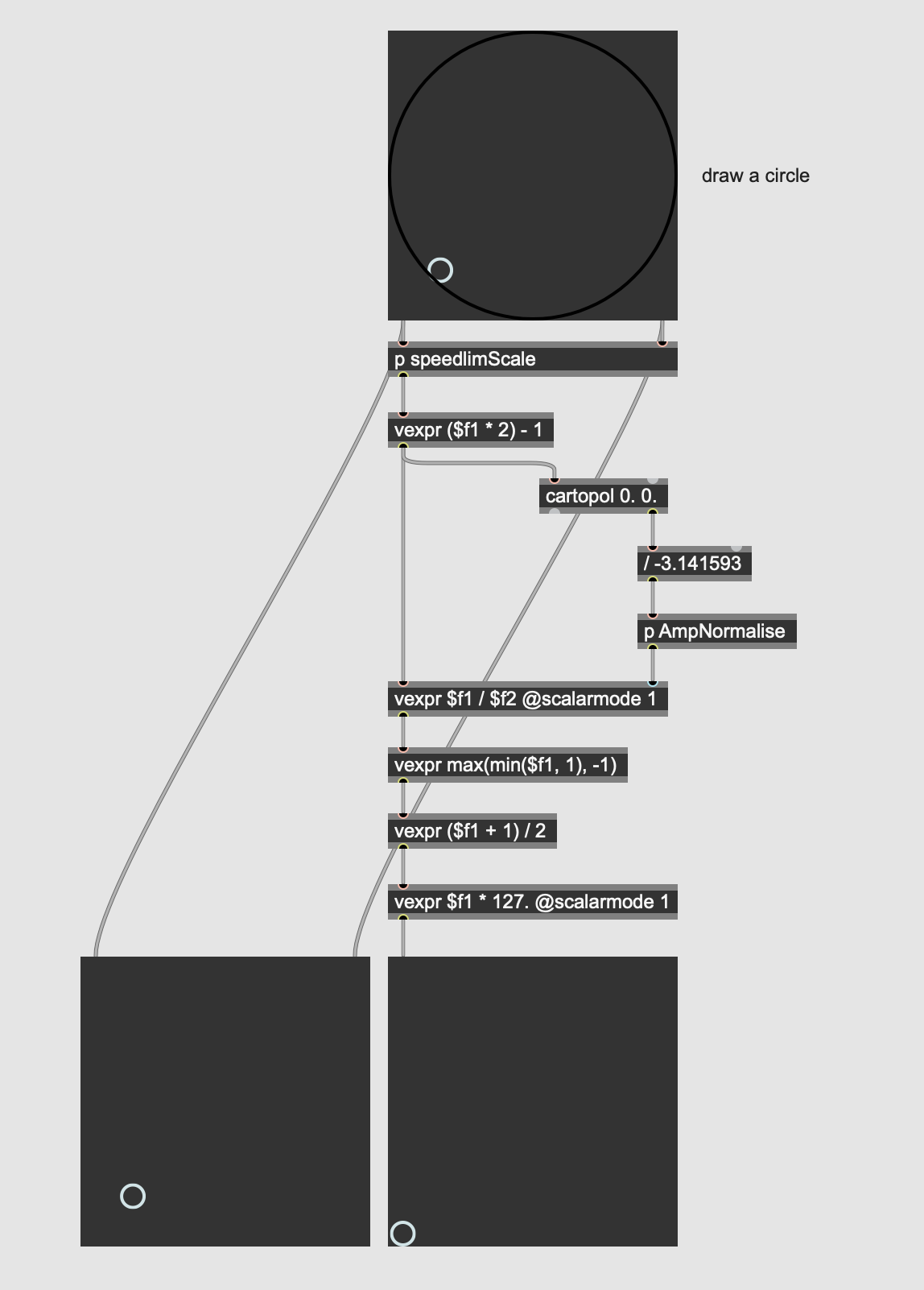
I have/use this old bit of code from @a.harker where it takes a circular input and stretches it out to fill a square. Very useful as most gamepads can’t actually reach the corners otherwise:

<pre><code>
----------begin_max5_patcher----------
1916.3oc6aszbaaCD9r7uBTM8PcpsLwC9P8TyzY5s1K8PO3zQCDEjMRoHYIg
rcZlLS+G1+REuHMoLoBkDgRlznCTivBP7seXwhEKfd+ESltL6IV4TvO.tELY
x6uXxDcQpBlX+8joanOEmPK0UaZb1lMrTwzqLxDrmD5xWUPeDPAw7h3DVkzz
sax1JRXBca8rkxWoaQ1x2dcTiZxSqpHzVXNUDeOO8tEErXgAjjfnYdWAf3P0
WgApmHuYdf+P0jObwEpGWMPcImlxR1OVKumlyZhokYEqXEwYIYEFD4ofvyOf
Jr7RE0eZq1qJGcfpNJTqy95mvHu5up6uMYqXMAOM8tDcAnPUss.3tVfGcUqG
O+xxKxxyJD7rT8qbl+wPv7XQYBWovcxxUTfoHw6LT8sfobkEl4qtXSzzZZpf
tgIXEKXozkIsz9V7JpedMRaDEfQujW+LRkCgioNaskFKkNk8nDiuvmvCrmxK
.e6ZH3U.HJbF3GKioIzBkcJ.1M+.6ie5lUHSOxYQQMmFgPiqhmCJyYrUI7M+
lTgYiglhvSOtwXju2KzzlMx3LZRsBNY5ZdB6AVQocpuEmR2I44MJdRilnXk2
Z7oDcUcQ7TSQA0EUvdfW0dRcozBIzERbusPSASeJnZX05TqHcKWCESgxwGKj
ziDoxoCk4zXSiUCXUhelL7mqIAOh5KLRyLXuF96TNFSxh+S1pFymjCN4rTdZ
dAqTtnGs1aXk3Ur0zsIhEqyREk7+1rRAZVmxWaQXmBU5fF9utfSSpUf6J3qx
RUfn0Hgp3pt6V.zWqa9MUFcMRo4czXo0jjV5QXoTI2VtjVnFnrNWPUBEYYIs
EU2tD1ZgUbNOMcGVTjk2uvB9c2um1tLSJby9d2ZIkK1lZjtPZSHVTRenMaKn
II1oqse8OQS4anBlfaFBPd0BMNXuuLtHKIok9Zj7PGRVIswiYOxWIt2rvYiw
aY044UFQSqGkWwuiUJZWlfdWY6RJEuyP5MJZ6R6b3EB1l7DoVztBxYG7RQ48
YOVZqXkgVSB34H.aNmtouuVkuOefs8CV4ED360Tdm9A+H9B20eHLbm23K7I1
aHjP8zkP+YHeYHj31K.LoZQ.qilwmTdaFOczYC7IxFXY.dcrbn6YiazQFbj7
w5jLpneRAdrjBxSGWTj+rPIqfm+EDo3eZFJtkRzf4HU6lAN+hfm75Uq8FhVi
wl3Epd1pep1QbSGu59OcE6oFQs74MCAOVFxNW4znHzHRQF8teNxqGF.0KC.G
hMBB4M1FIOGNWBOsuEo0.RIuapoLaaQbkEPkWQPavICLQvSqit81mWSA.G37
6CFE3ghhPSEcCJBGHJTFGNCEJuSCBE9tDDC1r.5PT3eH1lcCBagU6QbpZi.q
VX1zyBpPTvWtUXlL0bSuGTv4xcJtjlrSD0cE69EOCtOSxiDLvA4QpqbRN1oQ
56T4Q56AvKA2.PiRFUpBJXZ26du6TJ06l02G8PvlrO36hjM0fddE.cI35wI0
ZX34hdPyIF5A6N5QVyuSBWEK8l2H6qKUOuFd4XvTmMhx2DpEjL2cDkxL5F4S
z3mrV3AMgCcBDEIvtGehaxt6q2j+qYEanI7xCM4ts2cVS5gD3b6HhIe+Dn1.
Z97+OmQXH130wjYXhm9bEwJ6mulR3ulR3ulR3SIkvmRVJ1e5qHjiNSNlDT.G
3lzes5ryA7TvuHmOxySXkfr0f+8ebdFdNxzWP7O5zWXybS3.Yl5U9z99.+LM
VjU3bZo88No8Bx+DMIdqxRGjZwlAZqeAzFDU1JW583Feujb+du6YH.ZncTfY
eTAyaesVNCT3uWPyATqMuHCv9qs7GnIxpaL6ugb3IT6SEMFZV7ybB+iNKtmz
1+MWqtmLt4rLBNJ5DcJz4b6sqx3eH5beHHk4IbgjPUWMo8PpnONod0GmcgGC
6hOE10lSfP8BRgnyM6FmU5FCUe+y97dCUZ8dhN6mV2q.3YPhbiDXGwnm+o9V
FEq8jFb1YToiTniNSXe3YmLiL28HyYlJ2At+mL+nt1MZ6q4w4zMpI50.+ysk
JcYojWcioJY9mHOol.nH6+lw3lCmToyC6Df78b4ACpe6vAgCnywwf3i.2hC3
ghiF0bCeUdlbaEVij4Q56ZT.YFIJvCgla9DM+JfOpGQNSuPC1dy2o76PO4Sh
SgQvfGl8QNGGCZ5WfawA5P4i9M6UG+mdo+nYjPRjO1ZbOGWY22gHGoXpznML
8pxg7WtmzdOmxyMfq2Ir9S+HdBBb9IfYOhGr4fvBgt3.vhoEhr7rDSPkG38S
nmXIaQSNmkvg160mNRmd9SfngV6naLj1ty1rTWGtOZ5EquqVTq5T+uCC14v0
A0ydCnm8F6dNjLfdNrQrJGcO09ZS0WOQFidBOfdBOF5zvrXvcax3cFLYvcay
bhc8P5YuwfdGhIyXLNhGhJsCZFoIfCpqaOVuSfJnn.UzHXjuIwud0+ZrG3IA
Cklfm3.xPlWEDLBi7ACQkH6k+IDnhwIdvYQymSPj.yGnbCR8Kqikt145Ynf7
NWKictRFu75Xz+UwX2qggNLv9t9EW7gK9OHF2jAL
-----------end_max5_patcher-----------
</code></pre>

(though revisiting this now, it looks like drawing a smaller circle makes for some jerky movement in the output?)

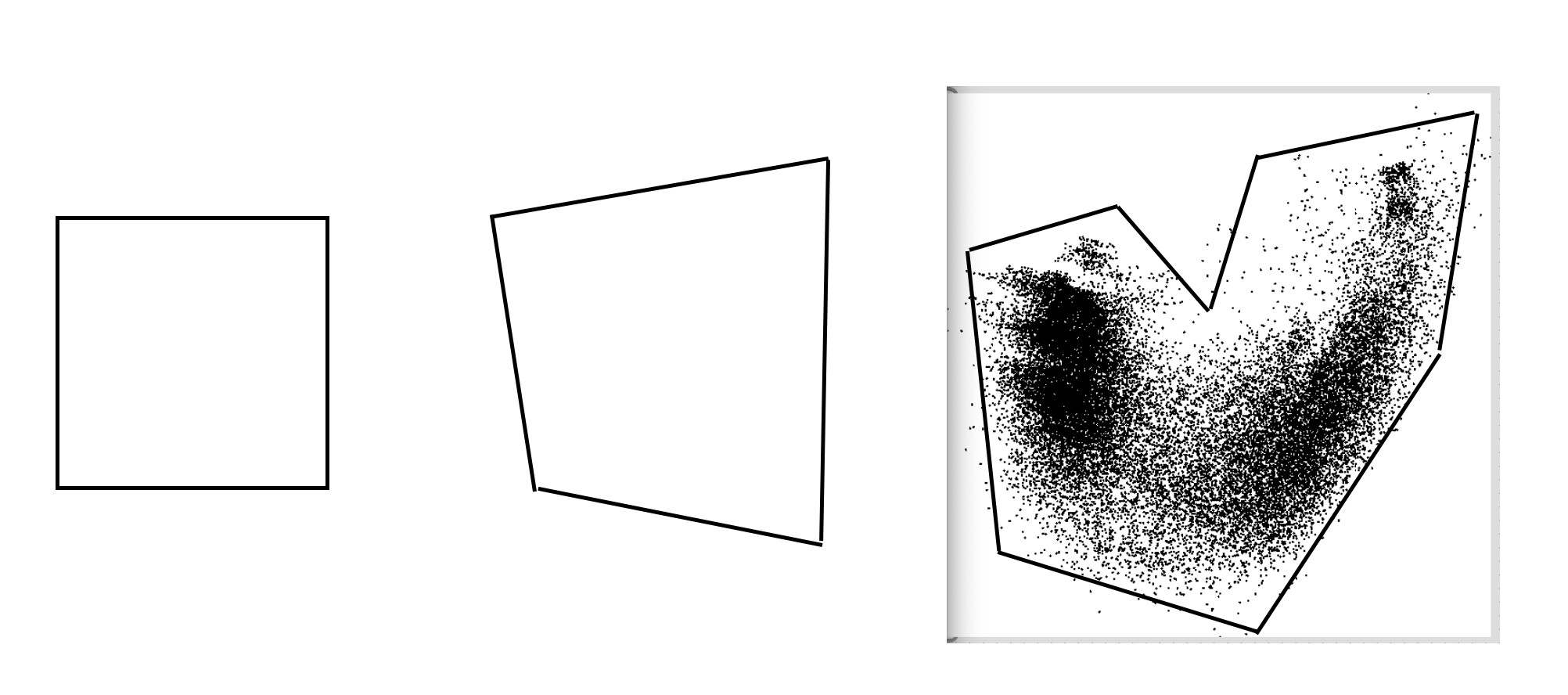
But perhaps something similar to this, but the inverse, where it maps the 2d square onto the UMAP “circle”.

A logical conclusion to that would be some kind of transform tool where you can take a 2d input and add additional points/dots to stretch/distort any normalized 2d input into any arbitrarily-shaped output as a mapping problem, rather than a data transformation one.

2 Likes

A bit tangential to the thread, but I managed to work this out.

For the first part, it seems that Alex’s original code was turning a circle to a square at all magnitudes, so I amplitude output of cartopol to scale the “square”-ness, which feels quite natural. Diagonal lines feel more natural, and curving/swooping movements are less jagged.

Then for the second transformation (square2circ), I do a similar process turning it back around. I can’t tell if it’s mathematically perfect, but the output definitely follows the circle shape.

<pre><code>
----------begin_max5_patcher----------
3239.3oc6c0siaqaD95ceJTM5EYS85PRIpe5EEMn.EnWbJJPunWjTrP1V1qx
QVRGI5Ma5AGf9F1Wox+jsjrDEsM0ZmrKBfSrnj4Leb3v4a3Pke81alLO64nx
IV+QqOYcyM+5s2bC+RrKbi762LYS3yKRBK421j7vznjISEsjGRV7Xb55GJhV
PD+JPf2LvTKHDJ9aevt+x5eKer4YEKiJVjkjUHdH98r+CXs6MdIuayl+k6cl
z34YWGIuR51MwoIQDtLBkWr7wv7n5WfdWYaIU2FPd0MYKip+8vz0I7Kf7XRi
rKW2PbQSa7wdwMuHKOqfDmkx+ImgYW92t8V1GSMDD6F3OVPr8qDHNM5qT0sR
YIQOyg1IOE8bdg0ueEz58VPj2Lq+b4hvjvBl7aAqtcgBR9lPy+j0jI6ksCGs
rCvL.2A4TavBg5F+gNfIpv6lvK7Dz7EYa1DkRNP0K+ksgEQVjhvzxUYEahVZ
QxrVDWrHIx596u+OovfDiE1THogoTGA8ni1AGgNBLnNJ0lV5nTyGPGQN3iRG
8uP53mkZ4mmXQ6g7sDE5jmicccJX.Ux8BoRv4yrVVD90JqwMgoaCSR9lJKRe
9rMrbPy1SolgfirlMjG8JeD3.S6PGhPutcomaUlGEsLIdy+j5JO5r7g6hQ53
CGY2o4Dpae306UwvyM6zvalrJNI5onhRIzHuaJbmmW6x2T6QXvxWDXt+zcWJ
NUbI2cWpH5o3pm2Y2UCKn5Ngp3aK3HyjmcqB6RNnWjtMd2hO7AHoHwGJRC2D
UlGtP7vrQrplqM4TXkC3SQsQ74l1fZ1CLCmjrE+bzxZVXzwr7nz3z7hnRpWh
vcVKUMuLZU31DxCqxRIkw+GgMLZVmsuRJgc1HSG3h+GKhCS1o.qKhWlkxDhF
iDrKW0czveENbv0UF9cjFl2wCSsWnvROMVRUxskyCKXCTykytpZjjkkzrocO
WRzJhr473zzVnHIKu+FKhW+nhmcdFswMp9s4sT9v1TQqOPsIHOTF9TSzlPce
Kmu17m+4vz3MgjHRrXH.A10XTZHUQerbQQVRRC8UzxSczxRpM9hnuFuj7nvw
Rswa5sGmWYDMY2n7x30QkjlWiDttr4UJIeS.50tz14x4vOPh1jmP0hl2.c1Q
bIo7wruVJuwJCs5.vd1X0mSW24WiqqxIXq.7jtAsvf5s2uiv9bF5.4l3d3YH
7TKO619BOvenW89qKWh8EZ6MUqBHczXdP4KYwoFAMroKZ04JCGFF00KZ7ANo
Gk3wpjrPxffBBvWnzGOyihJ1ACBJvWAfhvRQaLAeggDd+oTsiS0UossEqwW8
Ye5LBzqRC5Woq0REEh5Nd48Q5xnmuNQH4bEsgH3XCQHCBQBYXhN1HHDPSD.0
KB.6EA.mqQx9v4RhS6aQZtxwZuanoLaawhJaC4bbql5IMtDRb5tfa+z9EMX2
nViLGqPvrnzSJfioT.zTJvinPvBUQKgfYCNdRgstCHdioT.OFiSXmRg7hUbD
mvHBr7AAomGBIjh34aIhIS0I8dTAmSYJNOLoUD0cE69s6EtiM8MwTNZIwrrm
zW5CXd5m1zg+IlnmFYRvYeRiJnpFgRtPv1odpWzHKCHykPEdJxeGz5dVdxuy
5Obp4E2GyWwy2Sj6QekoTYGGhwJs3laHVmcmogpgt9FiGi8AoBW.hw8gRhFz
djGwUp5uio6TS66r9fE5L0WfLcWX056to5cm+JsfgZ+BsRhkoAH5c9Np7vvo
O+Yp1cG6y6g2cVXUfq.xbBTCU3uqfJlozGnehL3rn.QVSgdNpQJ2iAoPu.HU
e6wCZ9LqOK2DRZ30krsuZU0F9rlJJVkjhrz0QEVjGirVjjUJ+mQKWGY8srsV
zmr5mkElyhrshX7cTrodth4lhjXQcYyyxeudpgWnM.CMyJb4W1VRp.D9HYW5
JRUnGhMu.x0UOuJRmcqpfK0d8MiNPGVPrB2Rx1PC0bgTmUr6YN9bMStA61Hk
60GH3hswrBqac1XVGG+iXiYAdW18SONUs1.ccpqMttp0lwdalGLtVYvsn6nQ
+7tNWnCb2cm3JcN9AhndkNtsU4+1O3X1HwqvXfjzcnw.4qQLPA1eWst96DwG
SMSt+LqMH2.WA7nzZH.+JNBQIRE3ZqQDhA9udCPrBnfAZDfXPv0V7g8VEGeb
S9eOqXSXRbY+EwQyMhQQop4KRybfZhF.vnZG85qxOf1hHADo+xQrpfMKVz2J
8i2J8i2J8iyozOFd2H0bapEaDITuMiywwfaG4GY0PHkNg0OQmOFmmDUxRBv+
6+N56jqdaSobGZ8zDYvFbaJ2szG22m0eMbAIqXzgkl79Zth7eILYwVlktUpT
1Dh1pCDstXDJfOjqHKVhrvfT.lMJZld7xehvbOws7B.g+qhvbqPoMOIyJ5W1
F+TXB81El8evQOXzSrviu2PnH56UTTQ4476tmUuvFvuWfLsDtrB4x1evRVx8
jPSjVNEuXnYYdRLgBnrRzVGPc5wsphLQqdngQW3oft18htnqAzcQVowVfFQg
RpgJZ3ZqCiM6z9qBC00QolCJcDqFEvATkP4oT5Qv1xvdtdMU9d470GuuVOdW
7+5gCX+7.GlKXe7AavIrOdgKKym0brqN+PjuHAgRpThrfibraNjzMGQM3IpC
WwA4KpImQE7F0i63.7GGjC4f7HGfK4v7IGjSoF7J0ga4wvuTAGyA4YplqoZ9
lp4bpj2YebO6l+YObP0hGplbQ6lOZamMscheP6C4LuoC8+weqcSpqE+dKqHe
QpkphE9PO5s8p61ti6iEqpBttwJdMW0ajANJcYnYfNwNmJgNecfN322P26MI
tIL77v5fa1JwMz0NtQklCs45EXf1blU1ZgLNJQFnRjAn.YZtr5Akv8g.VWkK
aGv1AkMqa6plUQky1pvYOpAzSU9rOB4yoY4E+hHeviD+TKe0ZbeKidBIfl33
BIJT.nMmUBclzfbSf+XmOhwHcD.Www5dXNzfe.SGQ37RJtZLZzdbaTmgOOnN
AW5DRLJGlGGGcOvDL.X7N2FtHckC7g24l3k4Ywojxp2lSXtiGaa9oVDi1+sQ
S7ghUEGV7cG0CgiK7XgwwQNv5dHwbF0SFEVeqpwUNzdXoiAvVV2A97CssqaM
iaw2FMoGbrR+HJGZMICOpxQkmPMjCPuxwOHmxrdJ8o8YK8Lp2IOYhUOHE2Mq
2oio.2+g9EWSqzTebon9sRX5sRX5sRXxrbUdu08CvpdXB0016Ya3PrTbOkc5
6kg2ViTkex.g33xf.m96gDvkFHZk56S.JDGiNITLbMeb8BEevD3.DA5OG18V
NVWWutdZmaZEZq3zlZOn15bJEx2KUVGb0L.59eIML8E60Xh6HRkP22YFNiIc
liXrX.pLli+vhvBZPSYIhrnN.Uho5voPdF17juPqTeN9Any+HlfL5QLw3uMO
z8U8fG30wa5gcm5OsdSO3gG4WzCjr0qU7hecnAYL1q1dEHCUvoGcw8nGgG8W
nEqY0nM7TGKqzdr38oLR4Ho8HebUoLzKCWGcfJdu8LnCckb5mrXX.m3QyMfq
pXWwAMTolhtLGLW1ZQpbhybZMOLcsN5oPCcfpzS2tO.x1uLdkL2AP1V5IR84
O18p6XiRWKl9yelC2.b8YvG5Kl8lvOjTKGarjtEug1u0S5PCfBbxt4npW0OM
rNtNN1QvYmQpSk1NHwA9QcpSw9WFGB4gK9YqUVqNuYGh2PQNdplbf8FYMzbg
koy+EzTWyvuNBKqBVzKrLr6k48uEwZtByYt2N8HoDTOvkAl8hNBc0fixTVYj
LJ+LyQMqxmEFJ10GkivfImlsM+GqYNLDfPa9xRn3.dxAM10udHIydINTwR9.
3V6dxWmdpQtClr6+lLfieWyeCc0UeCNu9FqiZGLJpsNcMOq.0tqV6KuCvgMc
0ikQ1f8+AhPzUoDaZeGsYbPzVCMwCa.qT+.cGtf8BYBXIP3iGiC18MSO.qkv
Ba9lz0TCIdt5LjXafgDOcLi8.lnmzxLCYhdBoQO4FXfdxsosphwInI5ogzIr
IPOWsVJAOFl8Z007+qiy79ycA5.v9FXnDqiVhMwTNrmNSDLQ7GXcbXgMwZHX
jtiSFomf5LNc1VDZY64YBcBniN4Y.cp8zzdlLibLfVs6WYf9x1X8ETq95rwP
j8EyWrd8M1cL7E2NpJUbJNaLF5pUeYBeW69UFnuLxbBnVyIfFYNAzVq9xDgm
zlRU28kefw5pAmpCfFoufZwmDnhOojNjOkVYP.v111Cy+iyz9a5rkaftCGvg
DaWdgo6AP69VCgSjNlV0UKStZUOsspk1Cqi19qg110OKu1Y66092s+1s+eHn
dTGM
-----------end_max5_patcher-----------
</code></pre>

Actually reworked the square2circ part quite a bit as it was doing weird motions near the extremes:

<pre><code>
----------begin_max5_patcher----------
3343.3oc6cszajiaD9r8uBEgbX7D6dHodmSYQ.BPNjf.jC4vNKLTqltslUsj
VI0d8rKVf7OL+kBEIkZI05QoWss2wXATuVTRUUerXQVEqhyud8Upaidllpp7
mU9dkqt5Wu9pq32J+FWI+6qTO39rWfaJ+wT8hNbfFlodqnsL5yY76qsQwc2W
Nlloj5+KTknGTdxOI6nafR5OczMgV7BA9gTunig72RSdyX2LuG8C2eeB0KSv
MFFlaP2pnYYuw3VEas7+P2ZCR4GjuS3wCQGyBnYb9BIuq+NN2Ds8K2oYPTO8
r9gEOJN+d+10Wme4VfRcH8mYexyD5fH2cGnooJX0djDjNWRz3BjEJ+Jgzojf
aSRPEeewCl80Xp3iqpV8yrJBYJMPA0i7oirEhjPL0GP9HsHe51cJeacC2qda
mxIYBxYdOl6d54BZVTbOxolinqyhKtZ3IzOpaM19woHewtgzfdDDBl2Gg0rH
7esQk+LhQW55EjH8QWgXTHxaiR1QSp1YKtiWTPThfG3j7zEbcRWQOVdyCQ6n
U4DlVQ.+FD9.JIU1WiBjaqc4DEhShhiRx7iB4exMFSAj88xRC7ykykDoaczg
wIRj3dflQStmF5tMnFhblFketUZwOKmtUG1Hdh9bbhxe7ArxGYWIJ+kTO2.2
j7dsdsMRrE.ClvGTgszlvnJMyBJ7PTXV9zO7mjrAM7fs72Hjgo7u12k36Fnt
xPEGo9.V4NwEFZcCCz9.6U+.ifefgge9yLj3l7qnat4l9r7JlRAirkVfmD5g
tD1j5.LhU9tCw+ynjCtA9ozdDUScwPGj3WGmoHo3wpm7.aB9rQqrfqJFB6fW
UBKruhe.8IZRpz7i7oYlzhiqb6qp7J4X4WD10bts7V9ghagJuUB8I+h2+zcc
SXfYFCIOlH37mMKLcKMrlDdzubQC7dUIKw6+xk3zXWOwKm2MWz7otGrXZerA
ueQth.MqJqWK25bPj2OR2Uk6Tihog9gwIzT1hJcyZv7p6nO3dLH6916vp29C
RVr0Fasa6J08I96hByYhZcE42tfbLgyPHaUEF9SD5F2xKyz0X3RGMlxDxioa
cSx6ojVvIEMlEEETuox2Kf9Plr4X+vvFnHagKc2Xh+9G64c2FwZ7PeeadKo2
eLTz58Lkhr6ScepNZm4FDHGkW+y+ran+A2LZlunKffJaTLK1iodIQAA0jWQK
O0RK6XJ4dze1eW1ihYuqzeydb+3BkH0xd4c96ooY0uWl69z52IM6qBPuxsNt
UNH99L5g3.lTT+AXCO7SyReL5mSkOXghF5zXniTF90DTN40U0A5UMiV69MLm
xM1TNHtqYGNsNUMTw0RU3NsY1ztotdUBMfMxysFhpzPgyi7Ah4qfSwOT4evF
i5GGPSycZ7+8eqRL+vczmqXYRNsizH0DwNgD.C7PVfQOTGnmgZWHCtCjob9P
t8Pk+lqWVTxpCK0cru9zz+U2.ui4Z+JgRdSvZObFq0BThEvGwjikXSwT2SBL
0pRpNlSn2Ip6vQ4K.D9eRbiUbk57YQJze5n+StArGWn1+IcXvnkXxHaqoihj
W2nXskJVGD+C2k6s1..kio.ZLyCbjlcyEJB2vG1DJRAwn3HPSxkAMSiC7yX.
ZtCxFfrGJ8OS3M6.fJoKPEOOP814htZWFz0KJEDlRXXJSQk3LCEUCiWFE0Kz
v98rEQCBJENGxfRioCkjYsZGbS97j+e0E9N8CrKeAa75s4SXG9E1sugC6eXW
9HVyOwt7UbWZ7l58cU8YjXymJiHcuRWXoNumrJ71tei.7cDh+iC5CIP+H6wW
RX9SNfOkC5W4f9VNf+kC6i4f9YBvWSH9aNFeN6wuyA88re+O62Gz98CsWeQ6
xez18IsC+RA4aJP+S6xG018SsoQnlF2Oq8gLxW2P++5u2roVr0KB1ozTOpsY
M62beSS9lMoY2wAsCObq1V4Lg0mMbkANlazX.PmFoBzYOenC+6.n6ifwMghm
vAr4gaZyE2Hu73FikGgNGVrUEZPAOT2fmtZeHCtGjo9zs4Yhv.F23hS9y0Or
kFcLwqnmSZRQ4bIjMmPleX4BU99RcAErxOLoNzoxeZif+zEO6Ek+viD+5m+p
2sGwVihenTehwf2oizzrsUu972d0ClAdy.90X6HF7v8ngMRZF90f+VIVF.Ck
AhaPxzXFgxnLsb9cdnLb2lxvUPvpEWGUWaFAyP240SvLNsgemMawI7sMqbUP
4yrtoq2z7VGl13PQUia81MOV1fGdSX7gw4O4A+cwQ9gYRLAiL3Fmzz1Xw90f
b5uVM1GKl4bX1uPPWQ9XTv35vG4AADDenarprAbsp0kO.2szRGXCsaGdRnhM
MqnbK9qUi6Qik6WQ9.zfLiUkOJrDBfOPcxGmrl29h.KiDfZTpWJMbWirNr79
G2E6taGOdIpXh0FlC0avpm+P4YYHedZ1W2pRyrYMo9OQa6yKapwKaW4I9oiz
judV9+waJNg9f+ys8YEsHBPz0UCdqZdP01cuH3h26lkk3u8XlXptpYsznRth
8AQacCZDwo1x8hqO0CsLIT1ovM2SVj43n299D.IIxHp.yVrucxIrFw4ebw3+
87B687B687BagxKrdbh6iJ2Mb3Fpr89mWfCv8gyr28PsusO8x3Pas8YnafPT
QKsuGCv.BioBDnKCPzXeCZME8sp.EyIaZdkCEeBDNfInt2D.X.g1TAhKTnzZ
FX+d.CS6tCpOvzi7kObLl.8rnQf5WT+af55t4J5ikFzvGrl94Mh9hI4imC5a
Je7V5J7p0pT5N7MCWCb5hDbCqaMgJ2oL8DWuJ7ZJELKygO12.Po+Zy+w.MgR
iknCo3+XBh+AFqTcgus.J2Jqm1JfSxAWNyZ1a0W59bwmmspvWAkMnTmRlR4S
ppAIj2RUMXUjBuwXrHkr1kmFRgcdUN5CBRwraOVnRdvCHqU2QBUH8KQg520Y
v.Y6FkOqJNuEXKOJ8yp40VfmehW.UYOifJoYIQg6oIJYORU7BhRk+uzc6oJe
M5nRWmTC5ciaxhOEIzvvb2FMGWsjiLTWcro77oPhGb831DURepHhjYQDFQKQ
wAoMNQ0b0EU7FV+raRlh6wrHl4ceOoL22ga.hKYFxj0gzr5RfHYVKljkEsee
+rqkXPp7zln75XFpZO4ppujJoOsuZbeVMaZ6yK8JbuVuJPD6J8ii03kyknRv
65z23NsMXc1vI1Ul4CTem3HZXtrJVUkrbeF4TZujE8dt0lS4SQOBHVnXqimv
5FwXU3KC77jJYImKN2aAk+DyYAkOoP.LArnnKyynfIzwRda5of7zyoX36T7T
.q86XOEvaFVwgnM8s0CqOos0aIOJLb89QkGTd.vh4E4R6j7jFa7BZ3KSYaux
WgYOwffA6GacPf4fmjT8tMsKX+YTPVjmahHoDAn8JNWorrmxPeqAzdu8hoF6
E3GmKx8NfUmH5nkAP1XBdkRrGsqVZqvYoUgjLqyRKhky2zmkVKxpGJ5IHNjI
u7Ahk4aoPc.XJiRTQrjhAstzJnneQN05fbfpM9gasXtjXZ+l5.UaTQwpDgzH
SNLVDSmWvyaRvSbVpail7LmDyWfYNGbNEw5XMMzmwTJkmcEuOkRsyatzXJcW
f+g+Ma3Dc3NAacyYLLRazFN+16niSbjwgk6TFQdfKgdOCAeOCAeOCAunYHXg
oQk500VaFGwhcSzXCg4ht0bp1KqW4YC0Wh7CggFZHdYgXOizED+ZO2v9Dewn
CkbXh8Rx1fWsLZy4fMBOqCimWSfhPIYAvDiWMPBnCgRbwdjNuCgRBpWwtpOY
vOBJW8yTQHHjbzxB.Q3KEDQt3mFmxc.CM2SiSBYzmFmfURVkjSEZhgh0Vwrx
j.tTJWyZ.j.sjHW0xJ0BHSPV0Z8EZt5VvtqCWfGixIdRoqK48Rx7MSIYBKBt
iM3VsF0N82HAv8ChH3RtQ4t9iZq.UbDQAAilxFhYhdKs2EdtIYQwQACGkWwt
c6HpcTazTBx6D+G9gam5+BPTUOh+t0WRf.1ZZtUBdmWWF0OK.5phHHUpKiy5
h.Sq7+kXZXZoasHzxBBsptlhoSKMS.zhumxK.sHPjKsZyd17DmvTmm8CXDVa
iiCa5FMKi7+yjXcaeMNadGCh2QmlPeFzBjdMuma1zhX.ZLDYI5+I5fo07kKP
5Z3EQtvNfjKiEgVvrMrbzBChVyt+BaBhVVKFsFFCWDadXPiuvNKBs.M9BuHy
QU2Sqdwv42eAZrLZY5u.YmGatXzZPc97rOeAvPzkaMEHP1CwnEgVvVWV8mpb
e9QWBh2.NJINdlDGzncciWNhycGc4g8xUiN.wWB6b7DeC.sbVDZARtrVBaOk
b7.xk8hPKKPxk9hQKLHZgmMsfoGpsHxkND4xTaQjKMPxEZQjKLXecVbqXDSP
S.2vs0kxJlIbOJWIhiAYBEu7vNBj904qEQDxnFI0UNYZjLWMRjqyShqtSfql
IuEO1yckzVW+aW++AMQEQZB
-----------end_max5_patcher-----------
</code></pre>

Revisiting this again after some exciting email exchanges with @balintlaczko.

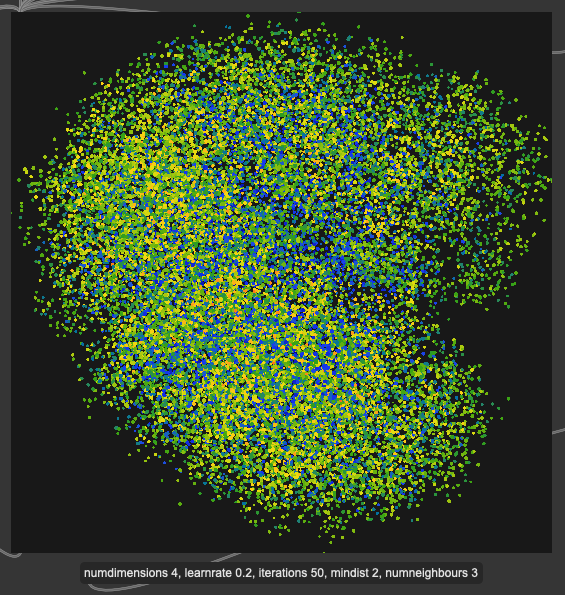
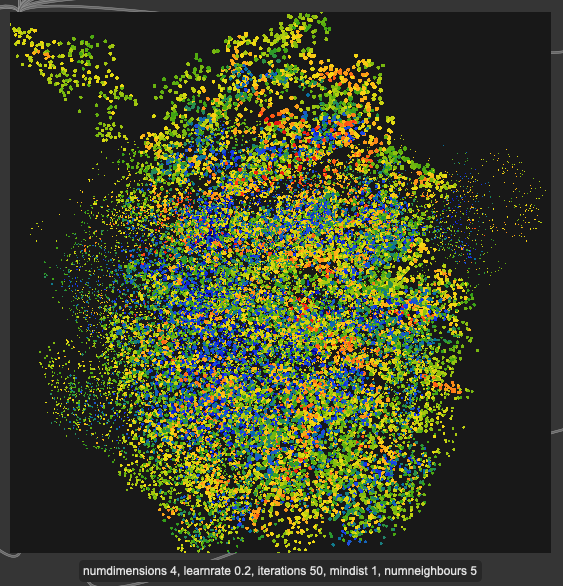
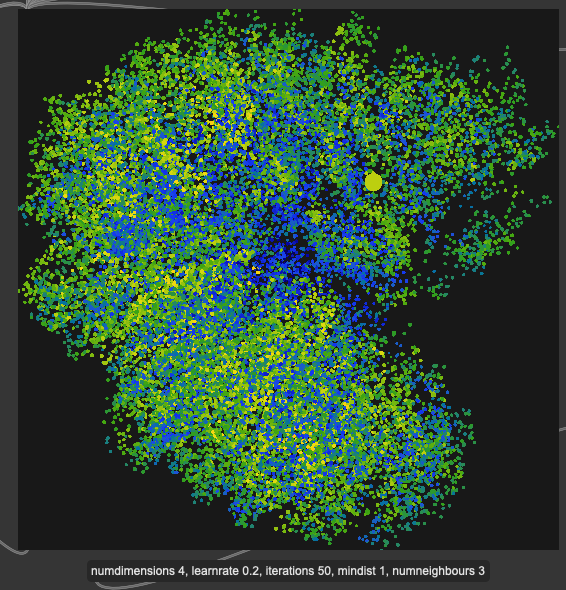
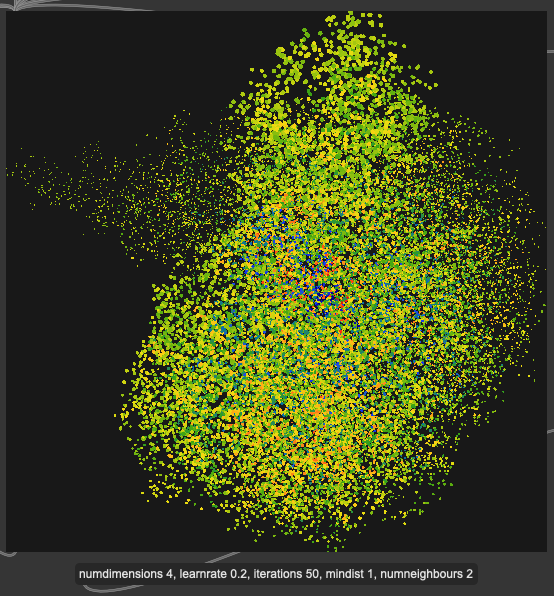
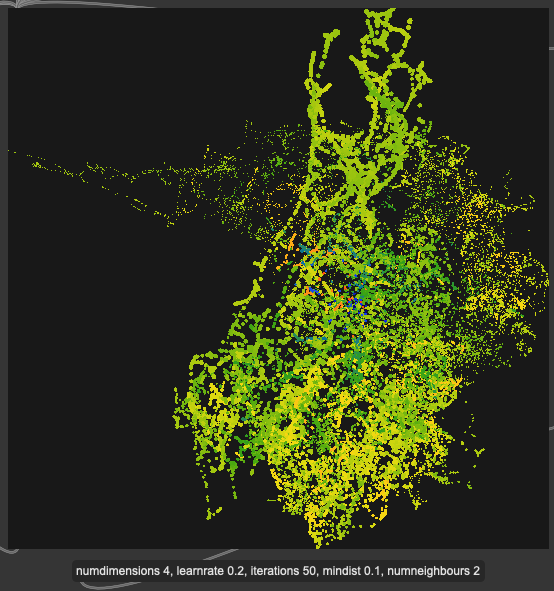
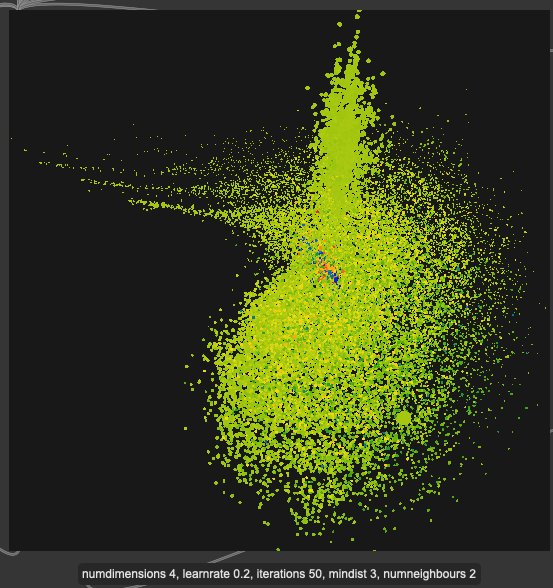
Here are some 4d (XY, size, color) projections using UMAP with different settings trying to optimize for efficient use of space and legibility. All of the projections below are using the same exact dataset (~28k points).

Probably the best so far (using same best settings above):

Covers the space well and sounds alright (though very randomish looking color distribution).

///////////////////////////////////////////////////////////////////////////////

This one has more local cohesion both in terms of color and sound in a kind of local/clustery way, but is a bit less evenly distributed overall (this browses better, but if I wasn’t looking and using a gamepad, there’s more empty space).

///////////////////////////////////////////////////////////////////////////////

This next one looks like a wrinkly version of the first one. Again, better clustering locally but more empty space.

///////////////////////////////////////////////////////////////////////////////

This starts getting more sparse in the higher-order space but browses nicely (though you can’t tell so much from the colors).

///////////////////////////////////////////////////////////////////////////////

Here we start getting into stringy territory:

///////////////////////////////////////////////////////////////////////////////

This seems to combine some of the “blur” from lower numneighbours with some of the wrinkly-ness from lower mindist.

///////////////////////////////////////////////////////////////////////////////

Although I didn’t list the duration for these, they were all between 9-13s (most being 9-10s) so are reasonably quick. It’s hard to balance the use of the space with visual legibility (and computation time).

1 Like

It’s outside the flucoma-verse, but you might check out Lloyd’s Algorithm. I’m using it for this purpose but in MMMAudio land.

1 Like

Interesting.

For my cases being outside of FluCoMa-land complicates stuff, but it looks like it does >2d and I assume from your recommendation it’s faster too.

Do you exclusively use this over the Jonker-Volgenant approach used in fluid.grid~ in MMMAudio (or your own stuff within MMM)?

I wouldn’t assume that. I’m not using it in a time-sensitive way so I haven’t benchmarked it at all.

That’s cool. I’m only using it in 2D. I use UMAP first to perhaps “unwrap” the manifold, then use Lloyd’s algorithm to spread the dots out to “cover the square.”

No. I’m not even sure it’s “better,” let alone what “better” means. But I think it’s an interesting algorithm and therefore fun to experiment with.

1 Like

@rodrigo.constanzo and @balintlaczko if you find a gridding algorithm that is significantly faster, we can maybe dream of an object, the same we we have PCA, MDS and UMAP for 3 different qualities of DR.

That would be very useful. And I agree, having a few flavors of grid-ifying would complement the DR nicely.

I’ve personally not played with stuff outside of a Max/FluCoMa context, so don’t have a point of reference other than what @tedmoore and @weefuzzy vaguely mentions earlier in the thread.

Maybe @jamesbradbury has messed with some of this kind of thing?

1 Like

Nup, sorry!

Hmm, can’t help either with that. I would have my own caveman-style approaches, but I have never studied how to do this efficiently.

As far as I see, you could want two types of things: 1) find an area in the dataset where you have a good coverage of samples in (nearly) equal-step distances (“fit a cube in somewhere a concave blob”), or 2) try to warp inter-sample distances to get a regular distribution (“iron the blob into a cube”).

I think the first one is probably easier to implement than the second, since with rescaling audio representations there is always a risk of distorting their perceptual relevance. But then you don’t get to use the whole dataset.

I also remember discussing with someone somewhere (maybe here in another thread) an idea to decimate a dataset with kmeans clustering, where you would use the cluster centers as “anchors” and sample points close to those centers. And the follow-up idea would be to draw axes between pairs of cluster centers and sample points close to those axes. It may not yield a regular area altogether, but it could “draw trajectories” between different groups of sounds. (Even on the fly..?)

That’s a good way to frame it.

I guess there’s also a use-case-centered way of thinking where you may just want to make the most of a surface area (e.g. trackpad, gamepad, touchOSC, etc…) where efficient use of the space is paramount and you would then kind of “learn” the projection.

Another way would be to perhaps take multiple individual reshapings/transformations/projections of several spaces and combine them into a single larger space where the goal isn’t so much making use of space, but rather creating relationships between spaces. So more of being able to distort and smear the projection ala photoshop brush or something.

Also reminds me a bit of the idea of a morphology between corpora as there could be overlapping sections in this too.

That’s interesting. I imagine that’s what UMAP and such are likely doing under the hood (conceptually), drawing local and global similarities and spacing things out.

But having a brute-force approach to that would be interesting.

kmeans is soon coming with new initialisation that is cleverer, albeit at a cost, so that approach might be fun to test indeed

1 Like